Welcome to our October 2026 edition of the Global Employment Tax and Compliance Newsletter.
October is when next year gets written. Governments table their budgets and set the minimum wages, contribution ceilings and permit fees for the year ahead. Employers are setting 2027 salary budgets and making offers in the same weeks, while many of those figures are still before parliament.
Every change in this edition is adopted and has a date, so each one can go straight into those budgets and offers.
United Kingdom: Autumn Budget 2026 – employment and immigration changes
The UK government presented its Autumn Budget on 28 October, announcing changes to immigration rules, sponsorship costs and minimum wages.
From spring 2027, occupation-specific salary thresholds for Skilled Worker visas will fall from the median to the 25th percentile of earnings, while the general salary threshold will be updated using 2026 wage data. The government also plans to remove the PhD salary discount and allow certain highly skilled sponsored workers up to six months to find a new employer if their employment ends.
The Budget introduces a tax exemption for employer-paid Certificates of Sponsorship and Immigration Skills Charges, covering both Income Tax and Class 1A National Insurance. Subject to legislation, the exemption will apply to payments made from 28 October 2026.
From April 2027, the National Living Wage will increase by 3.9% to £13.21 per hour for employees aged 21 and over.
European Union: revised social security rules for cross-border workers
The EU has adopted new social security coordination rules, published in the Official Journal on 27 October 2026. The regulation enters into force on 1 November, with the main changes affecting posted workers and employees working in multiple member states applying from November 2028.
From 1 November 2026, authorities issuing A1 certificates must conduct more thorough checks of the information provided. From November 2028, employers will generally need to request A1 certificates before international assignments begin. Posted employees must have at least three months of prior social security coverage in the sending country, while a two-month break will be required after a 24-month posting. Exceptions apply to business trips and certain short-term activities.
The revised rules also clarify how social security coverage is determined for employees working in several EU countries, making assignment planning and accurate documentation increasingly important for international employers.
Spain: new employment information requirements take effect
Spain introduced expanded employment information requirements on 5 October 2026 under Royal Decree 723/2026, partially implementing the EU Directive on transparent and predictable working conditions.
Employers must provide written information on essential employment terms before employment begins, including salary components, variable pay, working hours, probation periods and applicable collective agreements. The rules also require disclosure of automated decision-making systems used to determine employment conditions.
For international assignments lasting more than four consecutive weeks, employers must provide additional information before departure, including the destination, assignment duration, payment currency, allowances, travel expenses and repatriation arrangements.
Existing employees can request any missing information, which employers must provide within 30 working days. Changes to employment conditions must generally be communicated no later than the date they take effect.
Canada: Express Entry reforms prioritise high-wage occupations
Canada announced changes to its Express Entry immigration system on 16 October, with new rules taking effect on 3 November 2026.
The revised Comprehensive Ranking System will award points for eligible Canadian work experience or qualifying job offers in high-wage occupations, including engineering, IT and senior management roles. Depending on the occupation’s wage level, qualifying job offers may attract 50, 70 or 100 points.
From 3 November, employers will no longer need a Labour Market Impact Assessment (LMIA) for qualifying job offers used to establish Express Entry eligibility or obtain ranking points. However, LMIA requirements for temporary work permits remain separate.
Existing Express Entry profiles will be reassessed under the new rules, and candidates claiming job offer points should update their information before implementation.
India: reported increase in employment visa salary threshold
Indian immigration authorities have reportedly increased the minimum annual salary threshold for Employment Visas from INR 1.625 million to INR 2.4 million, an increase of nearly 48%.
According to immigration advisory firm Fragomen, the revised threshold is already being applied to new Employment Visa applications and in-country renewals. The change would affect employers recruiting foreign specialists or relocating international employees to India, particularly where proposed salaries fall below the new threshold.
However, as of October 2026, the Ministry of Home Affairs has not published a formal notification confirming the increase. The change is based on reported immigration authority practice and verbal confirmation rather than an officially published regulation.
Saudi Arabia: localisation requirement for accounting roles rises to 50%
Saudi Arabia increased its mandatory Saudisation rate for accounting professions from 40% to 50% on 27 October 2026, as part of a phased programme to increase the employment of Saudi nationals in the private sector.
The requirement applies to establishments employing five or more people across 44 designated accounting occupations, including financial managers, accountants, financial controllers and auditors.
To count towards the quota, Saudi employees must hold professional accreditation from the Saudi Organization for Chartered and Professional Accountants (SOCPA). Their registered monthly salaries must be at least SAR 6,000 for bachelor’s degree holders or SAR 4,500 for diploma holders.
The localisation requirement will increase to 60% in October 2027 and 70% in October 2028. Employers that fail to meet the applicable quotas may face regulatory penalties.
Argentina: new employer contributions to labour assistance fund
Argentina’s 2026 labour reform introduces the Labour Assistance Fund (Fondo de Asistencia Laboral, FAL) to help private-sector employers cover statutory employment termination payments.
From 1 December 2026, covered employers must contribute 1% of qualifying employee remuneration, or 2.5% for micro, small and medium-sized enterprises. These contributions will be offset by reductions in existing employer social security payments, rather than automatically increasing payroll costs.
Employers will report contributions through the existing social security system. Funds can be used for qualifying termination payments after at least 12 months of contributions.
Netherlands: tax-free expat allowance to decrease from 2027
From 1 January 2027, the Netherlands will reduce the maximum tax-free allowance under its 30% ruling to 27% of qualifying salary. The scheme allows employers to compensate eligible foreign employees for additional costs associated with relocating to the Netherlands.
The reduction applies to employees who started using the scheme in 2024 or later. Those who qualified before 2024 will retain the 30% allowance for the remainder of their entitlement, up to five years.
Higher minimum salary thresholds will also apply from 2027 to employees who first qualified in 2025 or later. Employees who entered the scheme in 2024 will retain the previous salary thresholds, adjusted for inflation.
South Korea: changes announced to skilled worker visa requirements
South Korea’s Ministry of Justice announced reforms to its E-7-4 skilled worker visa programme on 22 October 2026, aimed at improving long-term employment and residence opportunities for foreign workers.
The changes will simplify visa renewals, reducing the number of required documents from at least 12 to seven or fewer. Foreign workers who remain with the same employer for longer periods will receive additional eligibility points, while residence requirements for transitioning to F-2 long-term residence status will be relaxed.
The government will also pilot an online visa guidance service to help employers and applicants assess eligibility and documentation requirements. Implementation dates have not yet been confirmed, and existing visa rules remain in effect.
Global regulatory radar: what’s next?
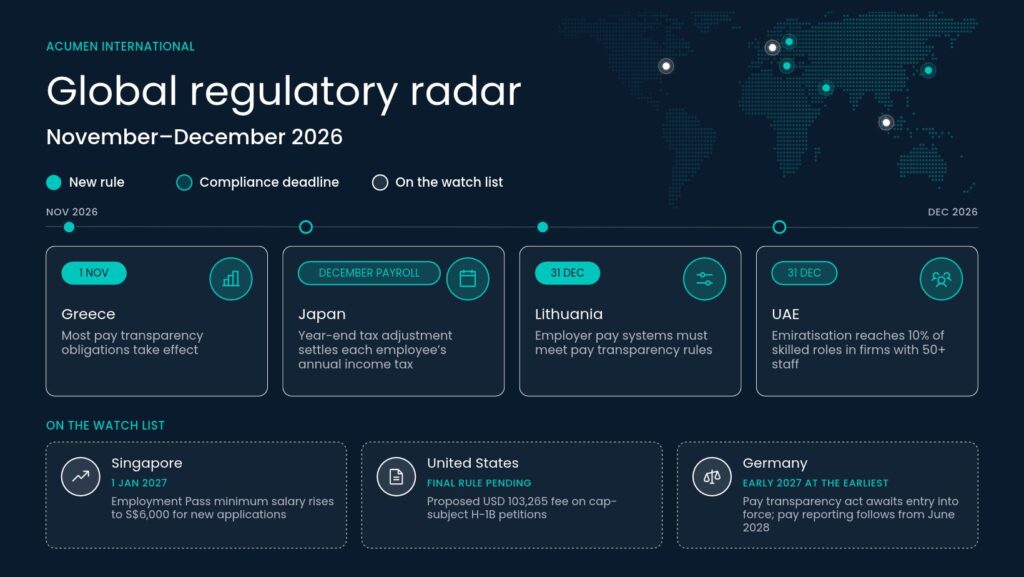
What should international employers prepare for before the end of 2026, and which regulatory developments deserve attention as we approach 2027?
With 2026 drawing to a close, here’s a quick look at what’s coming up across international employment and compliance.
Our radar highlights key deadlines for November and December, along with regulatory developments worth keeping an eye on as we head into 2027.
Acumen International launches new website and brand identity

Acumen International unveils new brand identity and corporate website
On 21 October, Acumen International unveiled its refreshed brand identity and new flagship website, acumen.pro, marking a new stage in the company’s development.
The launch reflects Acumen International’s strengthened focus on enterprise clients, complex international employment and strategic workforce advisory.
With over 25 years of experience across 190+ countries, Acumen International combines global employment infrastructure with specialist legal, tax and immigration expertise, dedicated account management and direct responsibility for employment obligations.
Our new corporate identity reflects the principle behind this approach: advanced technology, human expertise and professional judgement.
Explore acumen.pro to learn more about our services and capabilities.
Pharma workforce trends 2026: the role of Global Employer of Record

Pharmaceutical investment, clinical trials and competition for specialist talent are reshaping international workforce requirements. Companies increasingly need researchers, clinical specialists, regulatory experts and commercial teams across markets where they may not have established legal entities.
Our latest article examines global pharmaceutical investment and clinical trial trends, the challenges of recruiting specialist talent, and the employment, immigration and compliance considerations involved in international hiring.
It also explores how Global Employer of Record services support pharmaceutical companies with clinical operations, manufacturing expansion, market entry, acquisitions and workforce transitions.
13th and 14th month pay: an employer’s compliance guide
13th and 14th month pay: an employer’s compliance guide
Additional salary payments are mandatory in some countries, governed by collective agreements in others, and determined by employment contracts or established practices elsewhere.
Our latest article examines how 13th and 14th month pay works across international markets, including Brazil, Mexico, Spain, Austria, Peru and the Philippines. It explains how these payments affect annual compensation, variable remuneration, payroll deadlines and accrued liabilities when employees join, transfer or leave.
With several statutory payment deadlines approaching in December, the guide also addresses payroll budgeting and cash flow planning for multinational employers.
Stay informed. Stay compliant.
Thank you for reading the October edition of our Global employment tax and compliance newsletter.
If you have questions about any of the developments covered or need support with international hiring, employee mobility, payroll or compliance, our team is here to help.
Contact Acumen International to discuss your international workforce requirements.
We look forward to bringing you more global regulatory updates next month. See you in November.