
GLOBAL EMPLOYER OF RECORD in 190+ countries
Employer of Record (EOR) in Kazakhstan
Our Global Employer of Record solutions handle contracts, payroll, tax, benefits, and immigration in 190+ countries, so you build compliant teams fast, without incorporating abroad.

GLOBAL EMPLOYER OF RECORD
Global coverage
Acumen International delivers global employment solutions across 190+ countries.
Strategic markets
Hiring and compliance support across North America, Europe, and Asia-Pacific.
Established jurisdictions
Lawful employment and payroll in regulated, compliance-intensive countries.
Growth economies
Expanding into new regions? Hiring support across fast-moving economies.
Risky and Remote Locations
Compliant employment solutions in jurisdictions with limited infrastructure.
Staff your projects and offices in Kazakhstan without opening a local LLP, with payroll built on the 2026 Tax Code and foreign hires placed within the quota and Kazakh content rules.
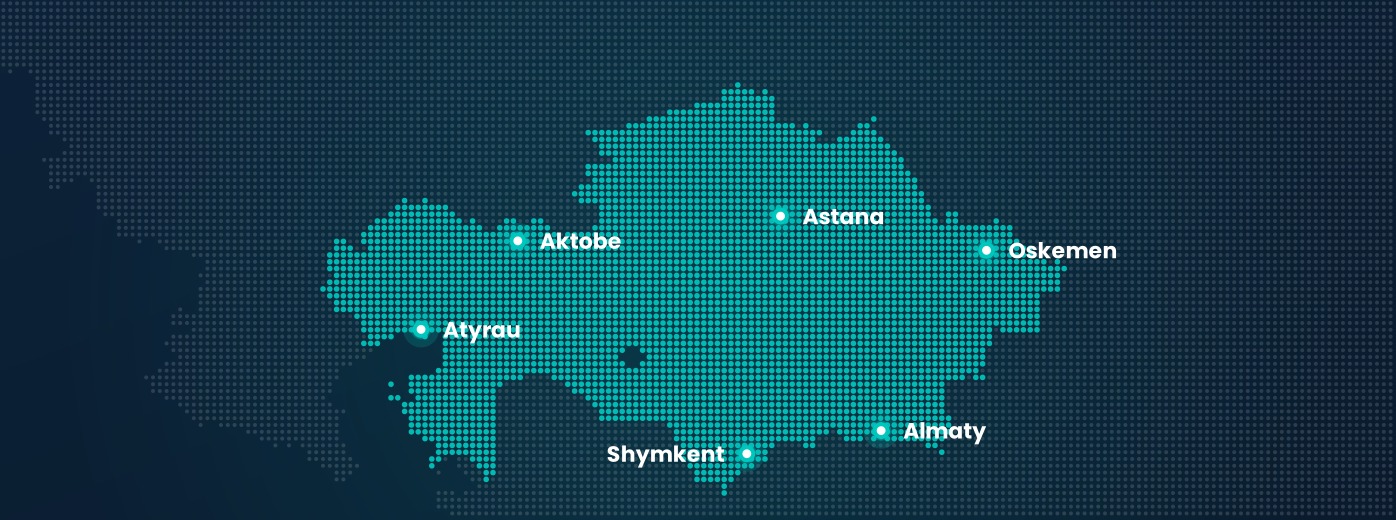
Acumen International employs engineers, project managers, finance professionals and international specialists in Almaty, Astana and the oil and gas regions of the west.
Employer of Record services in Kazakhstan
Acumen International acts as your Global Employer of Record in Kazakhstan. The employment contract is concluded between Acumen International and the employee, so Acumen International is the legal employer for the Labour Code, the State Revenue Committee and the State Social Insurance Fund. Your company signs a service agreement with Acumen International covering the role and the services, chooses the person, directs the work and owns the results.
The Labour Code calls this the provision of personnel, and allows it for a defined job or project, to replace an absent employee, for seasonal work and for domestic work. Acumen International builds each engagement on the right ground and term before the offer, and the client must not pay a provided employee less than its own staff in a comparable role.
Kazakhstan often anchors a Central Asian team. Acumen International employs people in more than 190 countries, so staff in Almaty can work alongside colleagues in Uzbekistan, Georgia or the United Arab Emirates through one provider.
Where the right person has not yet been found, Acumen International can also run the search, from specialist recruitment to executive search, with background and education checks before the offer.
How companies use an Employer of Record in Kazakhstan
- Oil and gas project teams in the west. A contractor or service company working on a project around Atyrau, Aktobe or Uralsk needs engineers and HSE staff for the project’s duration, and Acumen International employs them for that defined scope.
- Mining and metals programmes. A technology or equipment supplier commissioning work at a mine or smelter staffs the programme in Kazakhstan without registering a branch.
- Cover for childcare leave. Kazakh parents can take unpaid childcare leave until a child turns three, and Acumen International employs a replacement for the absent employee for as long as the leave lasts.
- Seasonal operations. Agricultural, construction and tourism businesses add seasonal staff, and Acumen International employs them for the season under the Labour Code’s seasonal rules.
- A market launch with a fixed plan. A company opening Kazakhstan as a market runs a launch programme in Almaty or Astana, and Acumen International employs the launch team before any LLP is registered with the justice authorities.
- Citizens of the Eurasian Economic Union. Professionals from Russia, Belarus, Armenia and Kyrgyzstan can work in Kazakhstan without a work permit, and Acumen International employs them after registering the employment contract.
- Specialists holding their own qualification certificate. A foreign professional in a priority occupation obtains a certificate of qualification conformity, outside the employer quota, and Acumen International employs them under it.
- Foreign managers and specialists under the employer’s permit. Acumen International applies to the local executive body for a permit in the right category and meets the Kazakh content conditions the permit depends on.
- Civil-law contractors who work like employees. People engaged under service contracts but managed as staff move onto employment contracts with pension, medical and social contributions paid.
- A bridge to the company’s own LLP. Acumen International employs the team for a set period while the company registers its Kazakh entity and prepares to take the employment over.
Payroll under Kazakhstan’s 2026 Tax Code
A new Tax Code took effect on 1 January 2026 and changed how salaries are taxed. Most thresholds are set in the monthly calculation index (MCI), which is KZT 4,325 for 2026, and the minimum monthly wage is KZT 85,000.
Individual income tax. Income up to 8,500 MCI a year, about KZT 36.8 million, is taxed at 10%. Income above that is taxed at 15% on the excess, replacing the flat 10% that applied before 2026. The basic deduction is 30 MCI a month, capped at 360 MCI a year, and mandatory pension and medical contributions are deducted before tax.
Employee contributions. The employee pays 10% to the Unified Accumulative Pension Fund, on pay up to 50 times the minimum wage, and 2% compulsory medical insurance, on pay up to 20 times the minimum wage. Both are withheld through Kazakhstan payroll with income tax.
Who is covered. Pension and social insurance contributions apply to Kazakh citizens, foreigners with a Kazakh residence permit and citizens of Eurasian Economic Union states on local employment contracts. A foreign specialist without residence status pays income tax but sits outside the pension and social insurance system.
Employer contributions and the cost of hiring in Kazakhstan
| Contribution | Employer rate | Base and cap |
|---|---|---|
| Social tax | 6% | Gross pay, reduced by the social contributions paid |
| Social contributions | 5% | Pay up to 7 times the minimum wage |
| Compulsory medical insurance | 3% | Pay up to 40 times the minimum wage |
| Employer pension contributions | 3.5% | Paid for each covered employee |
Because social contributions are credited against social tax, the two together cost the employer 6% of pay in most cases, not 11%. For a covered employee earning KZT 1,000,000 a month, the employer’s statutory cost comes to about 12.5% of gross pay: 6% social tax and contributions combined, 3% medical insurance and 3.5% employer pension.
The employer pension rate is scheduled to keep rising each year until it reaches 5%, so cost plans for multi-year projects should include the increase. The Global Payroll Calculator gives the full employer cost for any salary in Kazakhstan.
Hiring foreign nationals in Kazakhstan
A foreign national outside the Eurasian Economic Union needs a permit before an employment contract can be signed. The permit is issued to the employer by the local executive body for a named position and region, within a national quota that the Ministry of Labour and Social Protection set from 10 May 2026 at 0.3% of the labour force for employer permits.
Permit categories. Category 1 covers heads and deputy heads, category 2 heads of structural units, category 3 specialists and category 4 skilled workers, each assessed against professional standards. Category 1 permits run for one, two or three years. Categories 2 and 3 are issued for 12 months and can be extended. Category 4 permits are not extended, and the employer is expected to replace the worker with a Kazakh citizen.
Kazakh content. For an employer permit, Kazakh citizens must make up at least 70% of staff in categories 1 and 2 and at least 90% in categories 3 and 4. Breaching the ratio, or employing the worker in a different position from the one named, can lead to revocation and a 12-month bar on new permits.
Routes outside the employer quota. Citizens of Russia, Belarus, Armenia and Kyrgyzstan work without a permit under the Eurasian Economic Union treaty, though their contracts must be registered. A foreign professional in a priority occupation can obtain a certificate of qualification conformity in their own name, which sits outside the quota. Business immigrants and AIFC participants’ staff are also exempt.
Fees. The employer pays a fee after the permit is approved, set by sector and category and stated in MCI. For 2026 it ranges from 137 MCI, about KZT 592,500, to 513 MCI, about KZT 2.2 million.
What Acumen International contributes
- The route chosen for each person before the offer, whether a Eurasian Economic Union contract, a self-obtained certificate or an employer work permit, so the quota is used only where no other route fits.
- Acumen International as the Kazakh employer for the permit, with the position defined to match the category and the professional standard.
- Permits and residence kept valid through every extension and change of role, so the specialist’s right to work stays current for the whole project.
Employment in the Astana International Financial Centre
The Astana International Financial Centre (AIFC) runs its own Employment Regulations, based on English common law, for AIFC bodies and the companies registered as AIFC participants. Contracts must be in English, annual leave is at least 20 business days, and after the first month either side can end employment on 7, 30 or 90 days’ notice depending on length of service. End-of-service gratuity is a matter for the contract rather than a statutory entitlement.
AIFC participants can employ qualified foreign staff without a work permit, and foreign employees of qualifying AIFC financial services participants are exempt from individual income tax on that income until 1 January 2066.
Those rules apply to the AIFC participant’s own employees. A company that wants them has to register in the AIFC. A company that does not can employ through Acumen International under the national Labour Code, and Acumen International compares the two routes before the decision so the cost and timing are clear.
Labour Code essentials in Kazakhstan
Written contract and electronic reporting. The employment contract is concluded in writing or electronically and must state the job, place of work, term, start date, hours, pay and termination procedure. Its key details are reported to the state’s electronic employment system.
Fixed terms. A fixed-term contract generally runs for at least one year. Shorter terms are allowed to replace an absent employee, for a specific project or seasonal work, or to match a foreign worker’s permit. Extensions of one year are limited to two, after which the contract is extended indefinitely or for a longer term.
Probation. Up to three months, or up to six months for chief executives and their deputies, chief accountants and heads of branches and representative offices.
Working time. 40 hours a week. Overtime is capped at 2 hours a day, 12 hours a month and 120 hours a year, and paid at no less than one and a half times the normal rate.
Intellectual property. Work created in the course of employment duties belongs to the employer unless the contract provides otherwise, and the contract assigns it onward to the client.
Restrictive covenants. Non-compete and non-solicitation clauses are permitted, but courts generally want proof of actual damage, such as disclosure of trade secrets, before they enforce them. Confidentiality obligations carry more practical weight.
Termination of employment in Kazakhstan
Only listed grounds. An employer can end employment only on a ground set out in the Labour Code, such as liquidation, downsizing, a fall in production, unsatisfactory probation, or a breach of duties. A dismissal on any other basis is unlawful and can be challenged in court.
Notice and severance. For liquidation or downsizing, the employer gives at least one month’s notice and pays one average monthly salary in severance, and notifies the local employment centre a month in advance. Where the reason is a fall in production or services, notice is 15 business days and severance is two average monthly salaries.
Protected employees. Pregnant employees, mothers of children under three and certain single parents and guardians cannot be dismissed for downsizing or a fall in production. Employees on sick leave or annual leave are generally protected while they are away.
End of a project. A fixed-term contract for a project ends when the term expires, which is why the term and the provision-of-personnel ground are set at the start of each engagement.
Employment risks in Kazakhstan and how Acumen International mitigates them
| Risk in Kazakhstan | How Acumen International mitigates it |
|---|---|
| An engagement does not fit a ground the Labour Code allows for the provision of personnel | Sets the ground, whether a defined job, cover for an absent employee or seasonal work, and the matching contract term before the offer. |
| A provided employee is paid less than the client’s own staff in a comparable role | Benchmarks base pay against the client’s comparable Kazakh employees, where it has them. |
| Civil-law contractors managed as staff are reclassified as employees | Moves them onto employment contracts with pension, medical and social contributions paid. |
| A foreign hire starts before the permit is issued, or works in a position the permit does not name | Starts employment only once the permit or certificate is issued, and keeps duties within the named position. |
| The Kazakh content ratio is breached and the permit is revoked | Plans each foreign hire against the 70% and 90% thresholds before the application. |
| A category 4 permit expires with no extension available | Uses category 4 only where the role is time-limited, and plans the hand-over to a Kazakh citizen from the start. |
| Payroll is still calculated on the flat pre-2026 income tax | Applies the 10% and 15% bands, the new deductions and the 2026 contribution rates in payroll. |
| A dismissal is challenged as falling outside the listed grounds | Uses the correct ground, notice and severance for each exit and documents the decision. |
| A protected employee is included in a downsizing | Checks pregnancy, childcare and leave status before any notice is issued. |
| Ownership of work created by the employee is unclear for the client | Assigns all work product from Acumen International to the client in the contract and service agreement. |
Hiring cases in Kazakhstan and how they are handled
| Case | How Acumen International handles it |
|---|---|
| An Italian engineering contractor needs 15 engineers for a two-year upstream project near Atyrau. | Acumen International employs the team on fixed-term contracts tied to the project, with pay benchmarked against comparable client staff. The project is staffed without the contractor registering a branch. |
| A German equipment supplier needs a non-Kazakh commissioning specialist for 10 months at a plant in Pavlodar. | Acumen International files a category 3 permit for the named position within the regional quota and starts employment once it is issued. The specialist works in Kazakhstan lawfully for the full commissioning period. |
| A UK fintech wants a product manager in Almaty who is a Russian citizen. | Acumen International employs the manager without a work permit under the Eurasian Economic Union rules and registers the contract. The company has its hire in place without using the quota. |
| A US company’s Astana employee takes childcare leave until her child turns three. | Acumen International employs a replacement for the absent employee for the length of the leave, and the original role stays open for her return. The company keeps the position covered on lawful terms. |
| A consultancy has paid three Almaty analysts under service contracts while managing them full time. | Acumen International employs them with pension, medical and social contributions, and assigns their work product to the consultancy. The relationship is compliant from then on, while any exposure from the earlier period stays with the consultancy. |
Leave and benefits in Kazakhstan
Annual leave. At least 24 calendar days a year, with additional days for hazardous work and for some employees with disabilities.
Sick leave. Paid on a doctor’s certificate at average daily earnings for each working day off, within a monthly cap set in MCI.
Maternity and childcare. Maternity leave covers the weeks before and after the birth, with a social payment from the state rather than salary from the employer, unless the contract or collective agreement provides a top-up. A parent can then take unpaid childcare leave in full or in parts until the child turns three.
Public holidays. Kazakhstan’s national holidays include New Year, International Women’s Day, Nauryz in March, Unity Day, Defender of the Fatherland Day, Victory Day, Capital Day, Constitution Day, Republic Day and Independence Day.
Competitive packages. Professional benefit packages in Kazakhstan usually add voluntary medical insurance, a thirteenth-month or annual bonus and, on remote projects, rotation travel and accommodation.
Sources
- Labour Code of the Republic of Kazakhstan, Article 137-1
- Foreign labor quotas: who can work in Kazakhstan in 2026
- Kazakhstan: other taxes
- Individual income tax: key changes from 2026
- MRP and minimum wage in Kazakhstan for 2026
- Labour and employment 2025: Kazakhstan
- How labour relations are regulated in the Astana International Financial Centre
FREQUENTLY ASKED QUESTIONS
Got questions?
We’ve got answers
Have questions about hiring globally? You’re not alone. Below you’ll find answers to the most common questions from teams expanding into new markets — from compliance and onboarding timelines to payroll and local benefits.
If you don’t see what you’re looking for, our team of in-country experts is always ready to help you navigate the details.
Is Employer of Record employment in Kazakhstan limited to office-based roles?
No. White-collar roles are common, but technical and blue-collar roles may also be possible in Kazakhstan. Acumen checks the employment, worksite, safety, licensing and immigration conditions before confirming that the role fits an EOR structure.
Can payroll in Kazakhstan be funded or settled in an international currency?
Employee salary payments in Kazakhstan must follow the currency and payroll rules that apply locally. Where foreign-currency payment is permitted and operationally workable, it can be considered; client funding and invoicing can also be arranged separately in an agreed currency where supported. Acumen confirms the workable structure before onboarding.
Can we put technical or field staff in Kazakhstan for a client project through an EOR?
Potentially. Technical and field roles in Kazakhstan require more than a standard office-hire check: Acumen reviews the worksite, job duties, safety, licensing, immigration and employment terms before confirming the setup.