Pharmaceutical work now spreads across more countries than most companies hold entities in. Discovery sits in research hubs such as Boston, Basel, Cambridge and Singapore. Clinical trials run across multiple countries at once. New manufacturing capital is pouring into the United States, and launch teams are needed wherever a regulator grants approval.
The people who carry each stage are senior, specialised and in short supply: biostatisticians, clinical operations leads, validation engineers, qualified persons, medical science liaisons and heads of regulatory affairs.
For leadership teams, this changes the workforce equation. Capital, trial sites and specialist talent are each moving on their own timeline, and critical roles may be needed in a country well before establishing an entity there makes commercial sense. Global Employer of Record (EOR) services allow pharmaceutical companies to employ specialist personnel across international markets while aligning entity establishment decisions with longer-term business requirements.
This guide sets out where pharmaceutical investment and trial activity are moving in 2026, what that means for specialist hiring, and the employment rules that shape each hire.
Pharmaceutical capital is moving faster than corporate expansion
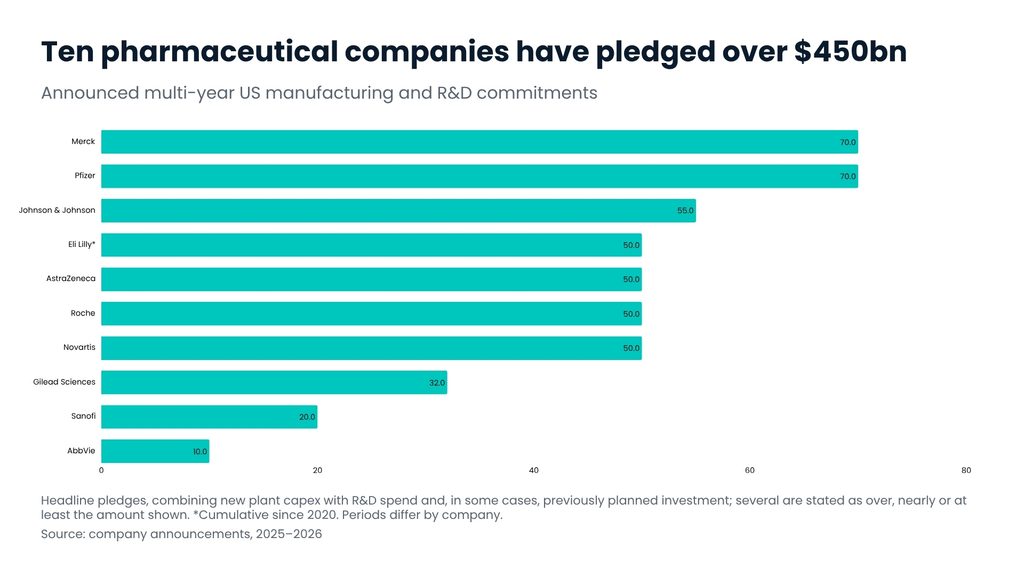
2025 was a record year for pharmaceutical investment in the United States. DPR Construction counted more than $370 billion in US manufacturing pledges, spread over five years. CBRE put the total for manufacturing and R&D closer to $600 billion, but found that only about $60 billion had a confirmed amount and location. Most of the money is still a plan.
Tariffs are part of the reason. Under the April 2026 Section 232 proclamation, imported patented medicines face a default 100% duty unless the company holds an onshoring or pricing agreement with the US government.
Deals are adding to the movement. EY counted $240 billion of life sciences M&A in 2025, 81% more than the year before. IQVIA tracked $130 billion of biopharma acquisitions in the first half of 2026, close to the whole of 2025.
The large companies behind these numbers will staff their new plants through their own US entities. The cross-border hiring happens around them. Mid-size biotechs make the same move without a local entity. Technology transfer and quality specialists are placed in countries where the local organisation is still being built. Experienced engineers are sent from established plants to new ones abroad. And carve-outs leave teams in countries where the buyer has no entity. Each of these needs an employer on the ground, and often a sponsor too.
Global clinical trial trends and workforce requirements
Trials have moved as well. Western Europe is still the most-used region, with 27% of trial country uses in 2025, but that is 17% below its 2019 level, according to the IQVIA Institute. The EEA’s share of global trial starts fell from 18% to 12% between 2018 and 2023, IQVIA found in its work for EFPIA. China overtook the US in Phase I trial starts in 2021 and was still ahead in 2025.
CROs run most of the site work, but sponsors still want their own people close to the study, such as clinical operations leads, medical monitors and pharmacovigilance specialists. When a trial opens in a country where the sponsor has no entity, employing them through Acumen International gives each person a local contract for as long as the phase runs, and a lawful exit when it ends.
Global shortage of specialist pharmaceutical talent
Finding those people is the harder part. In ManpowerGroup’s talent shortage survey, 77% of healthcare and life sciences employers say they struggle to fill skilled roles, the highest of any sector, against 72% across all employers. IQVIA calls the competition for R&D talent fierce, especially for people who pair technical skills with drug development experience.
With a pool that small, the best candidate is often in the wrong country. Companies that can employ that person where they live, or move them to where the work is, without first setting up a subsidiary, make the hire sooner.
Moving someone usually means a work permit, and permits go to employers that meet the authorities’ conditions. Acumen International acts as the sponsoring employer on the routes that allow it, builds the offer around the national salary threshold for permits such as the EU Blue Card, and handles renewals and changes of role with the authorities.
Key employment law considerations for pharmaceutical companies
Four areas of employment law come up again and again when pharma companies hire abroad.
- Pay transparency. Under the EU Pay Transparency Directive, candidates are entitled to a pay range before interview, employers can no longer ask about salary history, and gender pay gap reporting is on its way. Member states had until 7 June 2026 to bring it into national law. Only Italy, Lithuania, Malta and Slovakia made the deadline, and Greece has since followed. A company with scientists in several EU countries needs pay structures that hold up under each national version.
- Inventions and IP. In some countries, the law says more than the contract does. Germany’s Employee Inventions Act gives an employee-inventor the right to fair payment once the employer claims the invention, based on its commercial value, the person’s role and the company’s contribution. In the UK, the Patents Act 1977 allows compensation when a patent brings the employer outstanding benefit. Acumen International drafts the employment contract and the client agreement together, so ownership of the work passes to the client and the inventor’s statutory rights are respected.
- Worker classification. Clinical development has long relied on CRAs, regulatory consultants and medical writers engaged as contractors, sometimes for years. Moving them onto local employment contracts gives the client continuity for the programme and a clearer IP position.
- Tax presence. In pharma, permanent establishment follows the commercial roles. A foreign company becomes taxable in a country when someone there habitually concludes contracts for it, or plays the principal role leading to contracts the company then signs without material changes. That is the 2017 OECD standard, and the UK has applied it since 1 January 2026. The test looks at what the person does for the client, whoever holds the employment contract, so an employee engaged through Global EOR can still create a permanent establishment.
The exposure sits with a small group of roles. A country manager or key account lead who agrees pricing with hospital groups, a market access head who negotiates with payers, or a commercial lead who closes distribution deals can each meet the test. Medical science liaisons, clinical operations staff and most R&D roles rarely do, because their work does not lead to sales contracts, and promotion that does not directly result in a contract cannot create a permanent establishment on its own.
That makes role design the main lever. Before a senior commercial hire, we work through the role with the client and its tax advisers: who negotiates, who approves pricing, where contracts are signed, and what the title and job description say. Limits on authority go into the employment contract and are reflected in day-to-day reporting lines. When a market reaches the point where local staff need to close deals themselves, that is usually the signal to set up an entity, and we help the client plan that move.
How Global EOR supports pharmaceutical workforce needs
- Launch teams. Market access, medical affairs and commercial leads need to be in place before approval, while the regulatory file is still under review. We employ them in the launch country, so the team is ready when the product can be sold and the entity decision can wait until sales justify it.
- Trial oversight. When a study opens in a country where the sponsor has no entity, its own clinical operations, medical monitoring and pharmacovigilance staff still need a local employer. We employ them for as long as the sponsor needs them there, whether that is one study or a regional portfolio.
- New plants. Technology transfer, validation and quality specialists are usually needed while the operating company is still being set up. We employ them through that period and move them to the client’s entity once it can take them on.
- Research hubs. The scientist a programme needs may live in another country, or need to move to the hub where the work happens. We employ them where they are, or act as the sponsoring employer for the move.
- Contractor conversion. Many CRAs, regulatory consultants and medical writers have worked on the same programme as contractors for years. Moving them onto local employment contracts gives them statutory benefits and gives the client continuity and a clearer IP position.
- Acquisitions and carve-outs. After a deal, some employees end up in countries where the buyer has no entity. We plan the change of employer under each country’s transfer rules, so the team stays in place while the business is integrated or separated.
- Market tests and partnerships. A small team in an emerging market can support a licensing partner or test demand before the company commits capital. We employ that team for as long as the test runs.
- Bridge to an own entity. When the company’s subsidiary is ready, we move the employees across, with their contracts, benefits and service history planned in advance.
Acumen International — advisory-led Global EOR for life sciences
Acumen International employs the people pharmaceutical programmes depend on
Acumen International has been employing people across borders since 2000. Today, we provide Global Employer of Record services in 190+ countries, including immigration sponsorship where permitted under local regulations.
Acumen International assumes the legal employer’s responsibilities, manages employment-related obligations, including statutory severance, and conducts sanctions screening for every engagement. We also assess potential permanent establishment risk associated with senior or commercial hires. Our teams can employ staff in markets with exchange controls, arrange immigration sponsorship for scientists relocating to European research hubs, and support specialist hires for new US manufacturing facilities.
Pharmaceutical companies benefit from one accountable provider coordinating international employment, immigration and compliance across multiple jurisdictions.