
GLOBAL EMPLOYER OF RECORD IN LATVIA
Employ in Latvia without making incorporation the first step
Access the talent you need in Latvia without making incorporation the first business decision. Acumen acts as your Employer of Record, so you can make the hire, establish a presence and increase headcount in line with demand.

GLOBAL EMPLOYER OF RECORD
Global coverage
Acumen International delivers global employment solutions across 190+ countries.
Strategic markets
Hiring and compliance support across North America, Europe, and Asia-Pacific.
Established jurisdictions
Lawful employment and payroll in regulated, compliance-intensive countries.
Growth economies
Expanding into new regions? Hiring support across fast-moving economies.
Risky and remote locations
Compliant employment solutions in jurisdictions with limited infrastructure.
Employer of Record in Latvia: a Riga team without a Latvian SIA
With an Employer of Record, Acumen International signs the Latvian employment contract, registers the employee with the State Revenue Service and pays their social insurance, while the person works for your business under your managers’ direction.
Ways to put staff on a Latvian payroll
| Route | What it takes | When it fits |
|---|---|---|
| Your own limited company (SIA) | Share capital, registration with the Register of Enterprises, State Revenue Service registration as an employer and a Latvian payroll and accounting set-up | A long-term Latvian operation with several hires |
| Registering as a foreign employer | Registration with the State Revenue Service and Latvian contracts, social insurance and reporting managed in-house | Companies with Latvian payroll expertise of their own |
| Employer of Record | A service agreement with Acumen International, which employs the team under Latvian law | First hires, specialist teams in Riga and the period before an SIA makes sense |
What changes when Acumen International employs your team
- Hiring starts before incorporation. An offer can be made without forming an SIA or registering as an employer.
- Contributions capped and refunded correctly. Social insurance stops at the annual cap, and pay above it is handled under the solidarity tax rules.
- Exits that respect Latvian protections. Notice by dismissal ground, severance by length of service and trade union consent where it applies are built into every termination.
- Fast Blue Card processing. Latvia aims to decide Blue Card applications within 10 working days, and Acumen International files them as the employer.
- Tax reliefs applied through payroll. The monthly non-taxable minimum and dependant reliefs are applied as soon as the employee shares their wage tax booklet.
Who handles what
| Acumen International | Your company |
|---|---|
| Signs the Latvian contract and registers the employee before the start date | Selects the candidate and describes the role |
| Calculates pay, social insurance and income tax, applying the employee’s wage tax booklet | Directs the work and sets objectives |
| Files the monthly employer report and pays taxes on time | Agrees salary reviews, bonuses and equipment |
| Applies for work permits and EU Blue Cards | Provides the business reason behind any change to the team |
| Manages notice, severance and any union consultation | Approves the full cost before each offer |
Legal basis: licensed personnel leasing
Under Latvia’s Labour Law, a provider that employs staff and assigns them to work under a client’s management is their legal employer. Providers need a licence supervised by the State Employment Agency, renewed every three years, and must give each assigned employee the same working conditions, including pay and working time, as the client would give if it employed them directly. Your company provides the workplace and keeps it safe.
Latvian employment essentials
Last reviewed October 2026.
| Item | Latvia |
|---|---|
| Currency | Euro (EUR) |
| Capital | Riga |
| Minimum wage | €780 a month for full-time work (2026) |
| Social insurance (VSAOI) | 34.09% of gross pay: 23.59% employer, 10.5% employee, up to €105,300 a year |
| Income tax | 25.5% on annual income up to €105,300 and 33% above it |
| Non-taxable minimum | €550 a month |
| Working week | 40 hours, normally 8 hours a day |
| Annual leave | 4 calendar weeks, not counting public holidays |
| Probation | Usually up to 3 months |
| Employer notice | 10 days or 1 month, depending on the ground |
| Severance | 1 to 4 months’ average earnings, by length of service |
Latvia’s minimum wage, pay structure and overtime
The national minimum wage rose to €780 a month in 2026, with an hourly equivalent of €4.875 for a standard 160-hour month. Collective agreements cover a smaller share of Latvian workers than in the Nordic countries, so pay for professional roles is mostly set in the individual contract and reviewed against the market.
Two rules make Latvian pay distinctive:
- Overtime at double pay. Overtime earns a supplement of at least 100% of the agreed hourly rate, and it is limited to 144 hours in any four-month period.
- Night work. Work at night carries a supplement of at least 50%.
Offers for specialist roles are usually discussed as a monthly gross salary, with the employee’s social insurance and income tax deducted from it.
Latvian employment contracts, probation and working hours
- Written contract before day one: the contract is signed before work starts, and the employee is reported to the State Revenue Service as starting work before the first working day.
- Fixed-term contracts: allowed only for the purposes the Labour Law lists, such as seasonal work, a defined project or replacing an absent employee, and for no more than five years in total.
- Probation length: up to 1 month for fixed-term contracts under six months, up to 2 months for contracts of six to twelve months, and usually up to 3 months for longer or open-ended contracts. A collective agreement can allow up to 6 months.
- Ending probation: either side can end the contract during probation with 3 days’ written notice and no stated reason.
- Rest periods: at least 12 consecutive hours of rest in every 24 and 42 hours each week, longer than the EU minimum.
- Flexible working: employees with a child under eight, or caring for a relative, can request adjusted hours, and the employer must respond within a month.
- Non-compete agreements: possible for up to 2 years after employment ends, provided the employer pays monthly compensation for the restriction.
Ending employment in Latvia: notice, severance and union consent
A Latvian employer can end an open-ended contract only on one of the grounds listed in the Labour Law, and the ground decides the notice period and whether severance is due.
| Ground | Employer notice | Severance |
|---|---|---|
| Serious breach, unlawful conduct or working under the influence | 10 days | None |
| Lack of competence or health that prevents the work | 1 month | Yes |
| Redundancy or liquidation | 1 month | Yes |
| Reinstatement of the employee who previously held the role | 1 month | Yes |
Where severance applies, it is based on average earnings and length of service:
| Length of service | Severance |
|---|---|
| Under 5 years | 1 month |
| 5 to under 10 years | 2 months |
| 10 to under 20 years | 3 months |
| 20 years or more | 4 months |
- Employee resignation: 1 month’s notice unless a shorter period is agreed.
- Trade union consent: if the employee has been a union member for at least six months, the employer must usually obtain the union’s prior consent before dismissing them.
- Protected employees: pregnant employees and those within a year of giving birth, or breastfeeding, cannot be dismissed except in very limited cases.
- Challenging a dismissal: the employee has one month from receiving notice to go to court, which can order reinstatement and pay for the time out of work.
- Collective redundancies: larger reductions within 30 days require consultation with employee representatives and notice to the State Employment Agency.
Managing compliance risk in Latvia
| Risk | Where it arises | How Acumen International mitigates it |
|---|---|---|
| Worker misclassification | Freelancers paid under service or royalty contracts who work like staff can be reclassified as employees, with social insurance and tax due | Long-term freelance arrangements reviewed and moved onto Latvian employment where the work is directed like a job |
| Personnel leasing licence | Using a provider without the required licence exposes the client to sanctions and disputes over who the employer is | Engagements set up within the Labour Law’s leasing rules, with documents for your procurement file |
| Dismissal grounds | A dismissal on the wrong ground, without union consent or without the employee’s explanation can be overturned, with pay for the time out of work | Ground, notice, severance and any union consent prepared before a decision |
| Working time | Overtime above 144 hours in four months, missing supplements or incomplete time records | Hours, overtime and night work recorded and paid at the legal supplements |
| Equal treatment | Assigned employees are entitled to the conditions your own staff would have in the same role | Pay and working time aligned with your comparable roles |
| IP ownership | Rights in work created on the job generally pass to the employer, but the scope depends on the contract and inventions can carry a right to fair remuneration | IP assignment covering inventions, code, designs and content in both the employment contract and the service agreement |
| Pay transparency | The EU Pay Transparency Directive is being brought into Latvian law, adding pay range and reporting duties | Pay criteria documented for each role and applied consistently |
| Taxable presence | Latvian staff who conclude contracts for your company can create a permanent establishment | Each role’s authority to sign agreed with your tax adviser |
| Residence permits | Permits are tied to the employer and position, and changes must be reported to the immigration office | Role and salary changes checked against the permit before they take effect |
Work permits and the EU Blue Card for Latvia
Latvia issued 484 EU Blue Cards in 2024, more than the Netherlands, and remains one of the more accessible Blue Card countries in the EU. Non-EU hires start with an invitation from the employer approved by the Office of Citizenship and Migration Affairs (PMLP).
| Route | Suited to | Main conditions |
|---|---|---|
| EU Blue Card | Highly qualified specialists with higher education or equivalent professional qualifications | A contract or binding offer for highly qualified work and a salary of at least 1.5 times Latvia’s average gross annual salary, or 1.2 times for shortage professions; decision within 10 working days |
| Residence permit for employment | Other roles | The vacancy registered with the State Employment Agency before the permit is requested, unless the occupation is exempt |
| EU, EEA and Swiss citizens | Free movement | A registration certificate for stays over 3 months |
Blue Cards are issued for the length of the contract, up to five years, and family members can join the holder.
Payroll taxes in Latvia: VSAOI, income tax and the solidarity tax
Latvia funds pensions, healthcare and unemployment benefits through a single state social insurance contribution, VSAOI, split between employer and employee.
| Charge (2026) | Employer | Employee |
|---|---|---|
| VSAOI, standard rate | 23.59% | 10.5% |
| VSAOI for employees of state pension age | 20.77% | 9.25% |
| Business risk fee | €0.36 a month per employee | None |
The contribution cap and solidarity tax. VSAOI applies to annual pay up to €105,300. Above that, contributions continue to be withheld as solidarity tax at the same rate, but only 25% counts as tax; the State Revenue Service refunds the difference to the employer by 1 September of the following year.
Income tax. The employer withholds 25.5% on pay up to €105,300 a year and 33% above it, after deducting the employee’s social insurance. Employees who submit their electronic wage tax booklet to the employer receive the €550 monthly non-taxable minimum and €250 a month for each registered dependant. A further 3% applies to annual income above €200,000 and is settled in the employee’s annual return.
The Global Payroll Calculator shows the full Latvian cost of a salary, including the contribution cap and the solidarity tax refund, drawing on Acumen International’s 1,500-plus official sources checked with local lawyers and accountants.
Latvian sectors with specialist demand
Riga has become a regional base for technology, finance and service centres, while Latvia’s ports and timber industry anchor its western and eastern regions.
| Sector | Roles in demand |
|---|---|
| Software, fintech and IT services, centred on Riga | Software, QA, data and cybersecurity engineers |
| Shared service and business centres | Finance, procurement, HR and multilingual customer operations specialists |
| Transport, logistics and ports, in Riga, Ventspils and Liepāja | Logistics planners, port operations and supply chain specialists |
| Wood processing and timber construction | Process engineers, production managers and automation specialists |
| Pharmaceuticals and life sciences | Chemists, quality assurance and regulatory specialists |
| Defence technology and drones | Electronics, embedded software and test engineers |
Typical reasons to hire in Latvia through Acumen International
- You are building a nearshore engineering team in Riga. Nordic and Western European companies add developers and QA engineers in Riga, an hour ahead of Central Europe and in the same time zone as Helsinki, without opening a branch.
- One hire needs to cover the Baltics. A sales or partnership lead based in Riga can serve Latvia, Lithuania and Estonia from a single Latvian contract.
- Your best candidate needs a Blue Card. An engineer from outside the EU can be sponsored through Latvia’s 10-working-day Blue Card route.
- Your contractors are paid through royalty agreements. Developers who work full-time for you under copyright-fee contracts move onto Latvian employment, closing the reclassification question.
- A team member is relocating to Latvia. An existing employee moving to Riga for family reasons keeps working for you on a Latvian contract.
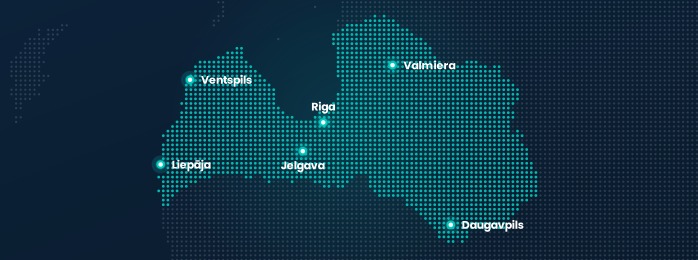
- You need operations staff near a port. Logistics and port specialists can be employed in Ventspils or Liepāja close to the terminals they support.
Benefits and Latvian payroll administration
Private health insurance is the benefit Latvian candidates ask about first, and employer-paid policies can be free of tax and contributions within set limits. Contributions to a private pension fund, extra days of leave, training budgets, sports allowances, a phone and an annual bonus are other common additions. Each package is tailored to the role and the candidate.
Payroll. Acumen International files the monthly employer report with the State Revenue Service by the 17th of the following month and pays social insurance and income tax by the 23rd. Holiday pay is calculated on average earnings and paid before the employee’s leave starts.
Annual leave, sick pay and parental leave in Latvia
| Leave | Entitlement | Pay |
|---|---|---|
| Annual leave | 4 calendar weeks, excluding public holidays, with at least 2 weeks taken in one block; extra days for parents of children under 14 | Employer, average earnings paid before the leave |
| Public holidays | Around 15 a year, including Līgo and Jāņi at midsummer and the independence days on 4 May and 18 November; the working day before a holiday is one hour shorter | Employer, full pay for salaried staff |
| Maternity leave | 56 days before and 56 days after the birth | 80% of average insured earnings from the State Social Insurance Agency |
| Paternity leave | 10 working days within six months of the birth | 80% from the State Social Insurance Agency |
| Parental leave | Up to 1.5 years for each parent, until the child turns 8 | Parental benefit from the State Social Insurance Agency, with part reserved for each parent |
| Sick leave | As certified by a doctor | Unpaid first day; employer pays 75% for days 2 to 3 and 80% for days 4 to 10; the State Social Insurance Agency pays from day 11 |
| Carer’s leave | 5 working days a year | Unpaid |
Sources
- Labour Law of Latvia
- 2026 payroll cheat sheet
- Employee leasing and who the employer is (2026)
- EU Blue Card: Latvia
- Latvia issued more EU Blue Cards than the Netherlands
FREQUENTLY ASKED QUESTIONS
Got questions?
We’ve got answers
Have questions about hiring globally? You’re not alone. Below you’ll find answers to the most common questions from teams expanding into new markets — from compliance and onboarding timelines to payroll and local benefits.
If you don’t see what you’re looking for, our team of in-country experts is always ready to help you navigate the details.
Can Acumen bridge employment during an M&A transition in Latvia?
Potentially. An EOR can bridge the gap between transaction completion and the point when the buyer or new business structure is ready to employ directly in Latvia. Acumen coordinates the employment transition, while deal-specific transfer and consultation requirements are assessed separately.
Can an EOR be used only until our Latvia entity is ready?
Yes, where the hire is suitable. Acumen can employ the person while your own entity in Latvia is being established, then support a later move to direct employment once the entity is ready and the transition can be completed correctly.
Can our employees in Latvia sit within the same EOR programme as hires in other countries?
Yes. Acumen can coordinate Latvia alongside other EOR markets through one provider relationship, while keeping each employee under the employment rules that apply locally. Global consistency can cover governance, reporting and service ownership without forcing identical employment terms across countries.